
When Carleton Watkins, Timothy O’Sullivan, Roger Fenton or any of the other great 19th century photographers wanted to bring back views of the American West, Crimean War or other locations in the form of 18 by 22 inch prints, they had to carry and use “Mammoth Plate” 18x22 inch cameras. Whatever size prints they wanted to do they had to shoot a plate of equal size to make a print. They also had to travel with a full darkroom and chemicals for preparation and development of the wet-plate negatives.
In contrast, modern day Photogrphy is much easyer.
We photograph with light weight equipment in comparison.
When we make silver gelatin, platinum
or inkjet prints we do it
from the inside comfort of a home, studio or dark room.
Early photographers used horses, donkeys and wagons to move
equipment around. While that sounds very difficult I only wish I had
a donkey when doing my modern day views in wetplate today.
While limited to about 1/2 miles walk from wherever a
car can go, many views are out of reach for us wetplaters.
Having a donkey in the trunk sounds like a good idea.
Another problem trying to shoot those same views are the modern
day obstacles; signs, parking lots, housing etc. Also, the fact that
conservation has actually ruined many of the outstanding park
views recorded by early photographers. This is due to
limiting wild fires in the parks, a natural process that cleared out trees and dead timber. Now blocked by over growth, many views of waterfalls, rivers and other scenes of interest are only partially visable. Yosemite and the California coast are just two prime examples that have dramatically changed over the years from these issues.
The equipment I use now:
For commercial work, I use Contax, Nikons and Hasselblads. For lighting, daylight when possible, also HMI's, strobes & tungsten lights.
Rarely do I shoot color film any more with digital replacing it, but if I do it is usually
for some unconventional look in larger formats
or something for strange processing or staining.
I usually use the a Zone IV 4x5 or the Deardorff 8x10.
For the Fine Artwork, I use the same equipment that was used long ago and
considered junk by most photographers today. I love this equipment and I
wouldn't trade it for anything. Working with it, I imagine, is like what playing
a Stradivarius is to a violinist! There is a life to this equipment, something
strange and unexplainable, but beautiful. Old and worn large wooden cameras
from the 1800's in sizes from 5"x7", to 18" x 22 " with beautiful
patina stained brass lenses the size of a coffee cans.
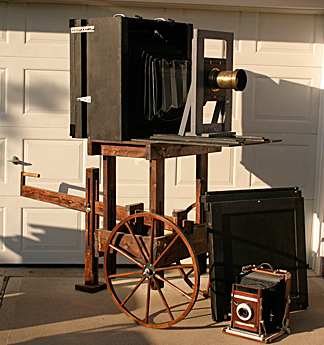
Then there is the Mammoth, my home made one of a kind 20" x 24" camera on <br />
a wagon wheel tripod. The Mammoth has a wet back that can hold
sensitized paper, wax paper negatives, glass or tin, plates. It is a complete bear to
work with but the results are nothing short of stunning.The 8"x 10" deardorf
in the photo looks like a toy in comparrison.
Completely simplistic although time consuming to use. You have to really think before you shoot when using this equipment. It is unlike shooting digital which is very forgiving and easily correctable. Each exposure with the old stuff doing the old process's range from a few seconds to several minutes. No meter is used, just experience from doing. The long exposures create a magical look due to movement, sometimes due to wind and moving water. Trees, leaves, rivers, water falls, everything not nailed down will look different from conventional work with fast films or digital, whether you want it to or not. Long exposures are just part of it.
Much time is spent setting up the darkroom, preparing plates, applying chemicals, processing printing and preparing for final presentation then cataloguing for sale. You don't want to waste time and supplies shooting a lot of images that may end up in the trash can while doing the old processes. A very different thinking process from that of the commercial world of photography. Done with film and digital imaging where you cover every possibility. Shooting hundreds of images to then edit for the one golden image.


